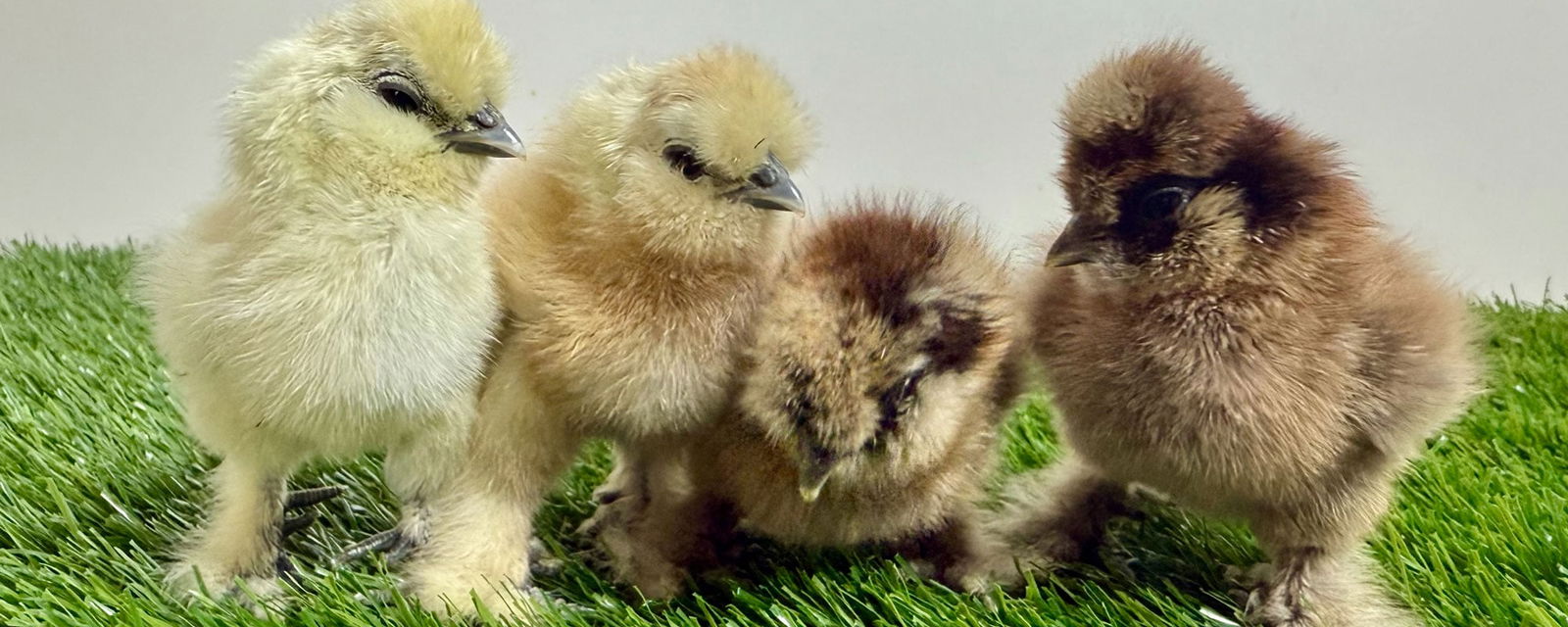
Image © Brittney Knight
For poultry breeders, knowing the sex of chicks in the first few days is critical. In many cities, noise regulations prohibit roosters, leaving almost no market for male chicks. But for many chicken breeds the chicks look identical at birth, and it can take months for physical traits to reveal whether a bird is male or female. This means that every day of uncertainty drives up the cost of operations, resulting in overcrowded pens, wasted feed, and delayed breeding.
Brittney Knight is a poultry enthusiast from Mississippi. When hatching large numbers of silkie chicks, she found that existing DNA sexing companies were too expensive and slow to be practical for a high-volume breeder. Brittney had no formal laboratory training, but she wondered if she should solve this problem by learning how to do the DNA testing herself.
“I didn’t come into molecular testing through a traditional academic path,” she recalls. “My background wasn’t in laboratory science: it started with a passion for poultry and a lot of curiosity, and asking “How do you DNA sex a chicken?””
In the beginning she was overwhelmed by academic papers full of jargon. She didn’t even know the term “PCR”, the core technique for DNA sexing. “But once I discovered that term, the scattered pieces began to make sense,” she says. “I could finally start connecting the dots.”
Learning PCR at Home
Brittney’s turning point came when she watched a YouTube demonstration showing bird sexing with Bento Lab. Unlike a university lab setting, the demonstration took place on a kitchen table, showing that PCR could be done outside institutional laboratories.
“For me, seeing it done in a home setting was transformative,” Brittney says. “I thought, ‘If she can do this like this, I can figure it out too.’”
She purchased a Bento Lab for herself, with a starter kit for bird sexing.
“What helped tremendously as a beginner was how integrated everything was.” Brittney says. “The thermocycler, centrifuge, gel electrophoresis, and visualization were all built into one compact system. I wasn’t trying to learn multiple pieces of equipment at once.
“And the bird sexing kit involves a complete workflow. The kit walks you through everything from DNA extraction from feathers, through thermocycling to amplify the DNA, to visualising your results on an agarose gel.”
For someone without formal lab training, having everything in one place made getting started much easier. Brittney didn’t have to assemble protocols from research papers or source individual components. She could focus on understanding the science behind each step in a clear workflow, and learning how to apply it successfully.
Learning the Science
Brittney used samples from her own flock while learning the bird sexing workflow: initially making some mistakes, but adjusting, learning, and troubleshooting. Some gels were failures, some were faint, and some weren’t as clean as she wanted. But after a few runs the processes all finally clicked.
She had finally managed to successfully amplify DNA from both male and female birds and visualise them on an agarose gel: one fluorescent green DNA band for a male, two bands for a female.
“Seeing two clean bands for the first time was a turning point,” Brittney recalls. “It wasn’t theoretical anymore. I had run it myself, and it worked. I laughed out loud and did a full celebratory dance in my living room.”
She practiced repeatedly, refining controls, documenting tweaks, and learning to interpret gels accurately. “Write everything down,” she emphasizes. “Every tweak. Every result. You think you’ll remember it later, you won’t.”
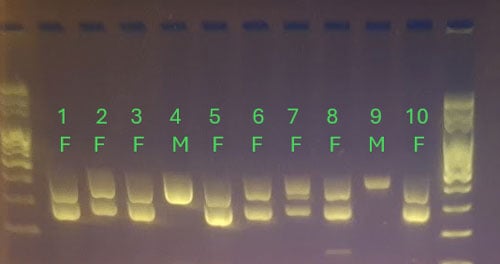
Example bird sexing results on an agarose gel, showing female birds with two DNA bands, and male birds with a single DNA band.
From Hobby to Professional Lab
After mastering the workflow, Brittney posted about her bird sexing testing on social media to find out what sort of appetite there was for it in the community.
“When I finally mentioned my testing online, I expected mild curiosity, but the response was overwhelmingly positive. Breeders shared the post, strangers reached out with encouragement, and it quickly became clear that people weren’t just interested in the service — they were actively rooting for me to succeed.
“That support meant more than I can articulate; it felt less like business growth and more like a community saying, ‘We believe in you. Keep going.'”
Brittney slowly began offering testing to friends and local breeders online. Interest and sales quickly escalated, first regionally, then nationally, and eventually internationally. Her first lab space was a walk-in closet, but she soon moved to a spare room to allow for more space, and ultimately a purpose-built laboratory space.
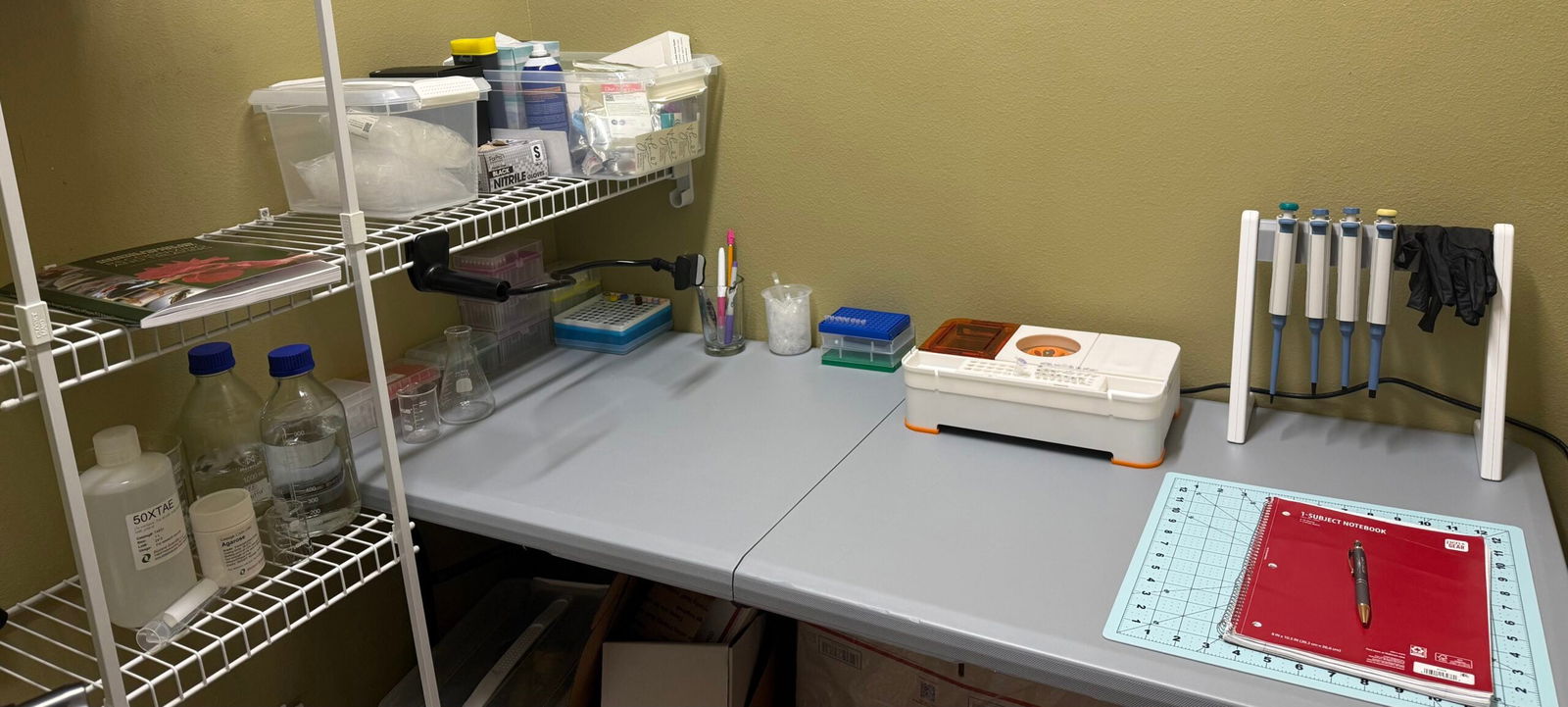
Brittney’s early bird sexing lab set-up.
Image © Brittney Knight
“Each physical move represented a stage of growth,” Brittney explains. “From a closet to a dedicated facility, each step ensured that accuracy and reproducibility were maintained as demand increased.”
She also expanded her equipment, buying higher capacity thermocyclers and electrophoresis gel tanks to allow her to run more samples at the same time. But her Bento Lab still has a place in her lab to provide extra capacity when needed.
Today, Brittney operates Knights Poultry and Lab, LLC, providing DNA testing for poultry, ratites (ostriches, emus, and rheas), and parrots worldwide. She is now learning how to use quantitative PCR (qPCR) to expand testing capabilities while maintaining rigorous quality standards.
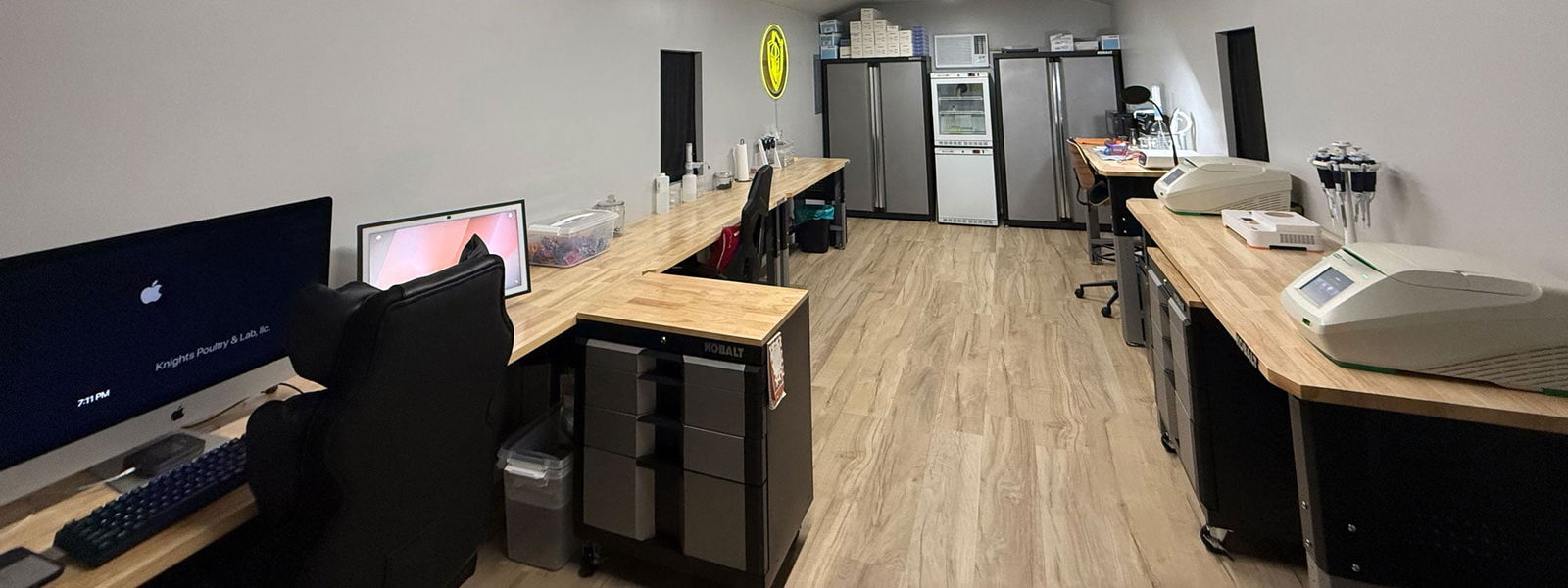
Brittney’s current bird sexing lab.
Image © Brittney Knight
Advice for Beginners
Brittney offers practical guidance for anyone starting with PCR:
“First – breathe. You’re going to get frustrated at some point. That’s normal. You don’t need a PhD. You don’t need years of academic training. Bento has created something that normal people – people like you and me – can understand and put to real use.
“Learn the language first. It’s PCR via gel electrophoresis. Google it. Watch the Bento YouTube videos. Follow the protocols exactly before modifying anything.
“Repetition is everything. Learn how to pipette accurately, and practice until it feels automatic – pipetting matters more than you might think.
“Write everything down. Every tweak. Every result. You think you will, but you will not remember it later. Don’t rush it. Let your confidence come from reproducibility, not speed.
“Ask for help if you hit a snag. The Bento Bio team has been incredibly supportive along the way.”
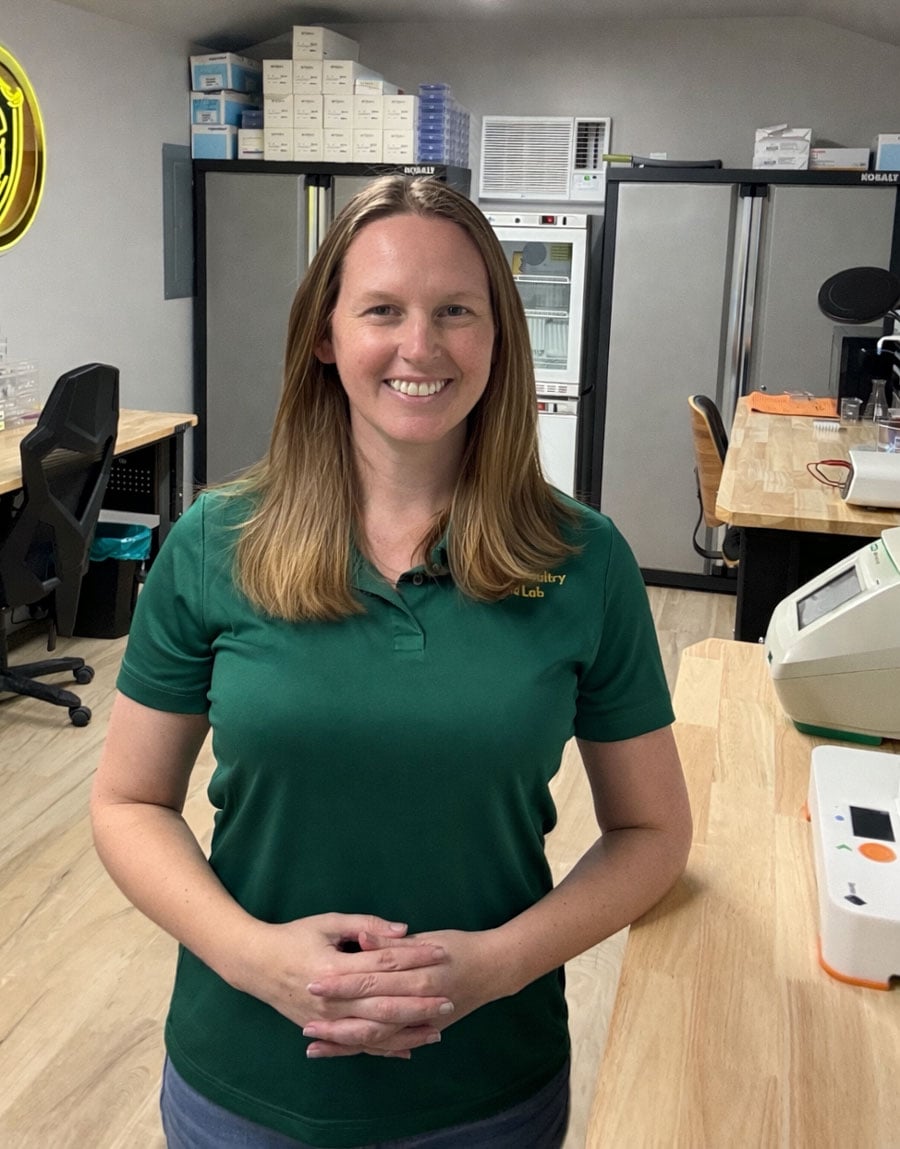
Image © Brittney Knight
You can find out more about Brittney and Knights Poultry and Lab, LLC, and the services that she offers, on her website, on Facebook and on TikTok.
Seeing Brittney move from a closet lab to a professional operation is exactly why we built Bento Lab, and we’re so excited to see and share her success story!
Brittney’s story demonstrates that molecular testing doesn’t have to remain in institutional or commercial labs, and that it’s entirely possible to build up your own commercial lab. With curiosity, patience, and persistence, beginners can go from their kitchen table to accurate DNA testing, gaining skill and confidence in the hands-on work, and gaining actionable insights into their flocks.
If you’re interested in finding out more about bird sexing with Bento Lab and our bird sexing workflow, you can read about it on our bird sexing resource pages, and please get in touch if you have any questions.
Looking for advice on using Bento Lab?
Book a free consultation or ask a question.