Bitterness Tasting

Reagents

Consumables

Equipment

Abstract

Do raw broccoli or brussels sprouts taste bitter to you? An evolutionary explanation is that bitterness tasting developed to help animals detect toxins or poisons in food. But not everyone perceives bitterness equally.

What are we testing?

In this project, we are analysing a gene called TAS2R38, which affects your ability to taste bitterness.

The TAS2R38 gene contains genetic information for a taste receptor that can detect  chemicals like phenylthiocarbamide, or “PTC”. Bitter foods, such as vegetables like broccoli and brussels sprouts contain molecules that similar to PTC.

There are two forms (or alleles) of this gene: C or T. The C allele is associated with the presence of the receptor, and thus the ability to taste PTC and bitterness. The T allele is associated with an absence of the receptor, and thus an inability to taste PTC and bitterness.

Overview

TAS2R38 gene variations

You can taste bitterness flavours thanks to your tongue receptors. One of these receptors is the Taste Receptor 2 Member 38, which is responsible for detecting PTC. The presence of this receptor is determined by the gene TAS2R38. You will explore two forms of the TAS2R38 gene: The T allele and the C allele.
C allele is associated with the presence of the receptor, which means you could taste PTC and bitterness.
T allele is associated with the absence of the receptor, which means you could not taste PTC and bitterness.

What are the possible results for this experiment?

There are three possible results, since the gene has two variations, and two occurrences of the gene exist – one from each chromosome:

  • Homozygous dominant: Both copies of the gene contain the C allele, which means the person can taste bitterness.
  • Homozygous recessive: Both copies of the gene contain the T allele, which means the person is likely to be unable to taste bitterness.
  • Heterozygous: One copy of the gene contain the T allele, and the other is C allele. The C allele is dominant, so the person likely to be able to taste bitterness.
Protocol

In this project, you will first extract human DNA from saliva. This will take about 20 minutes. After this, you will use PCR to amplify the variations of the TAS2R38 gene. This will take about 90 min, but most of it will be waiting time.
Finally, you will visualise the results using Gel Electrophoresis, which will take about 45 min.
At the end of each section, you can continue right away, or store your samples and continue later.


  1. DNA Extraction

    First, obtain the DNA sample. Use the DNA Extraction from saliva protocol. It will take ca 20 min, at the end of which you should have a clean DNA template sample in a PCR tube.

  2. PCR

    In this step, you will use PCR to amplify part of the TAS2R38 gene. The sequence of gene fragment we are copying includes a C/T mutation, that contributes to taste perception. This C/T mutation is also known as a single nucleotide polymorphism (SNP) with the code rs1726866.

    The experiment uses a method called ARMS PCR. This method uses 4 primers: 2 outer primers that copy the whole fragment, and 2 internal primers, each one specific to either the C or T mutation. This allows amplification of DNA only when the target allele is present in the DNA sample.

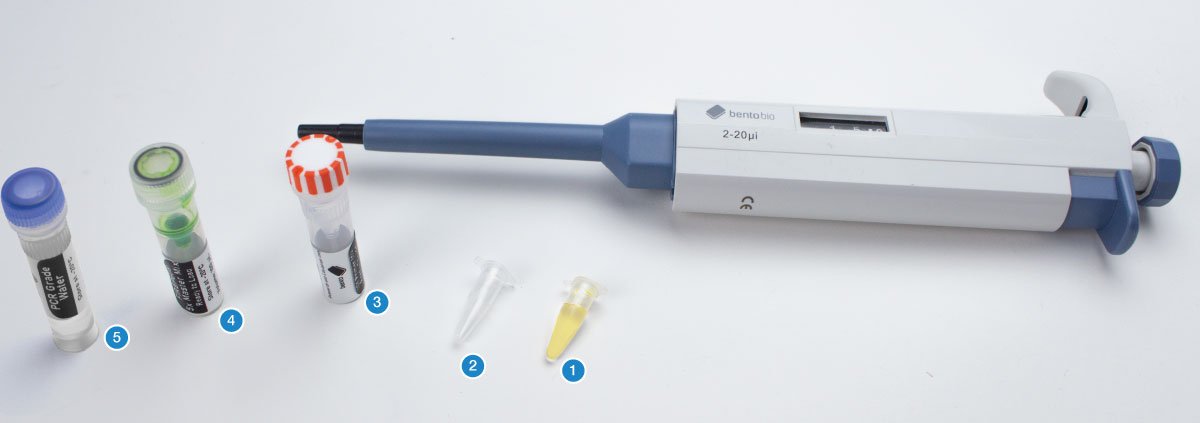
    You will need the DNA template sample (1), an empty PCR tube (2), the primer mix for this project (3), the 5x PCR mastermix (4), and PCR grade water (5). The total final volume of your tube will be 20 μL.

    First add the mastermix. Set your micropipette to 4 μL.

    Using a fresh pipette tip, transfer 4 μL of the 5x PCR master mix into the empty PCR tube. Then discard your tip.

    Next add the primer mix. Set your micropipette to 2 μL. Using a fresh pipette tip, transfer 2 μL of the primer mix into the PCR tube. Then discard your tip.

    Now add the DNA template. Set your micropipette to 2 μL.

    Using a fresh pipette tip, transfer 2 μL of the DNA template sample from the sample tube into the PCR tube with the mastermix and primer mix. Then discard your tip.

    Finally add PCR grade water to make the total volume up to 20 μL. Set your micropipette to 12 μL.

    Using a fresh pipette tip, transfer 12 μL of PCR grade water into the PCR tube. Then discard your tip.

    Place your PCR tube in the thermocycler block.

    Set up the thermocycler with the following PCR program:

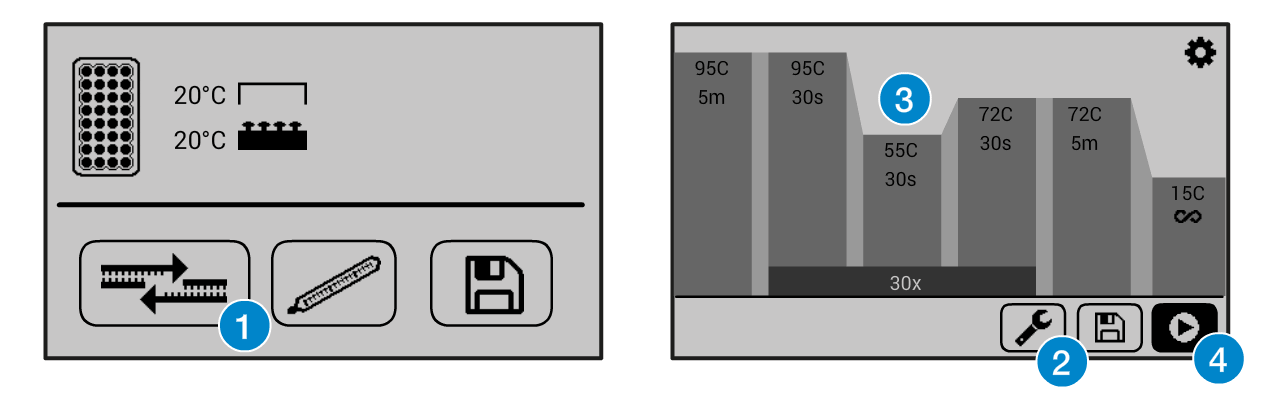
    If you need help operating the Bento Lab thermocycler, check the manual. You can use the PCR  preset (1), then modify (2) the program to the required settings (3) before running the program (4). This figure shows example settings – please consult the specific protocol for recommended PCR program settings.

    The program will run for ca 2 hours. When it is finished, you can keep the result in the freezer, or use it right away for gel electrophoresis.

  3. Gel Electrophoresis

    Follow the Gel Electrophoresis Protocol to cast a gel and run it with your PCR result, and a 100bp ladder. This should take about 40 min.

  4. Visualising the Gel

    You can now visualise your gel by placing it on your Bento Lab’s blue light transilluminator.

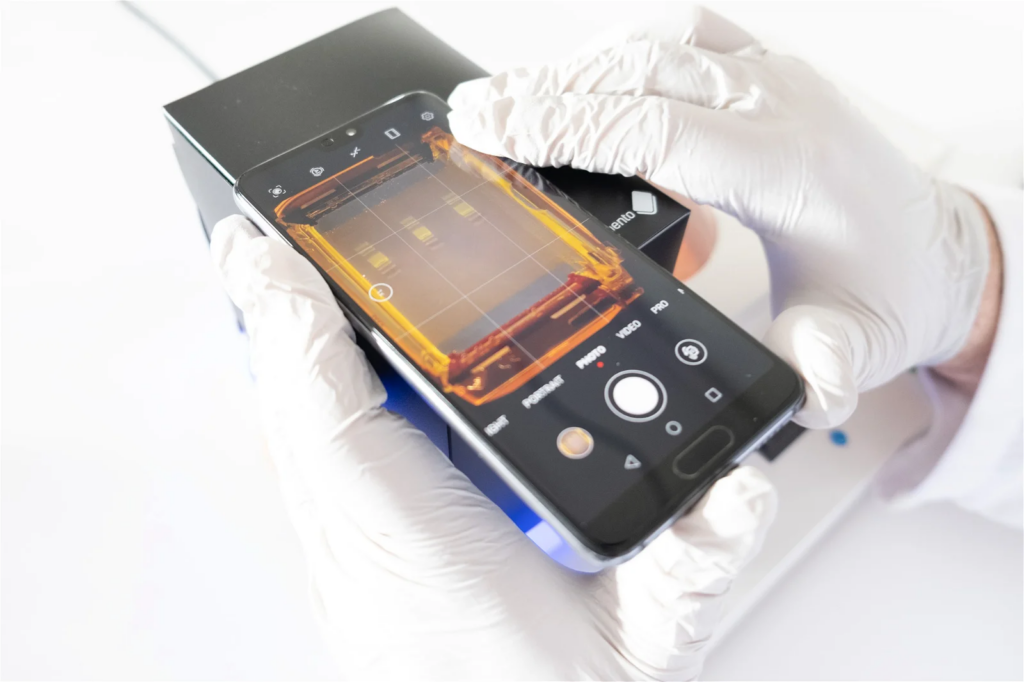
    For best visualisation you can use a smartphone camera to take an image of the gel using the Gel Imaging Hood (included with Bento Lab)

    To do this, place the gel tray open on the blue transilluminator (being careful not to spill any of the running buffer), and place the assembled Gel Imaging Hood over the gel tray.

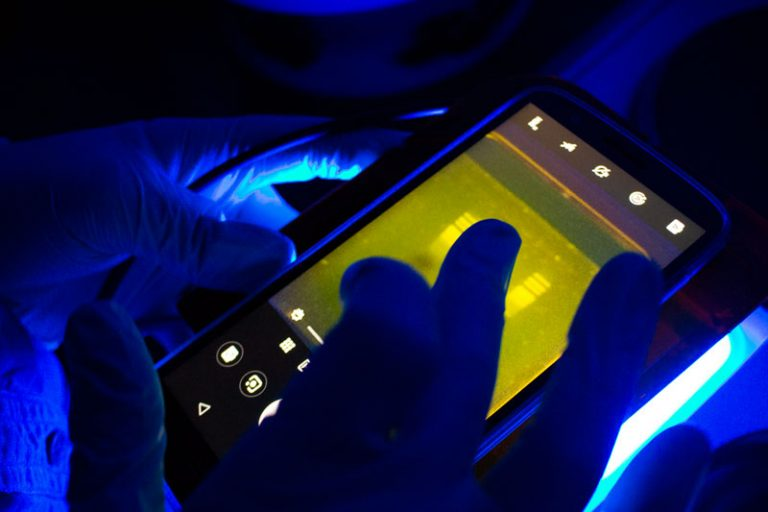
    For ideal visibility, imaging should be done away from direct light. The darker it is, the better the contrast will be.

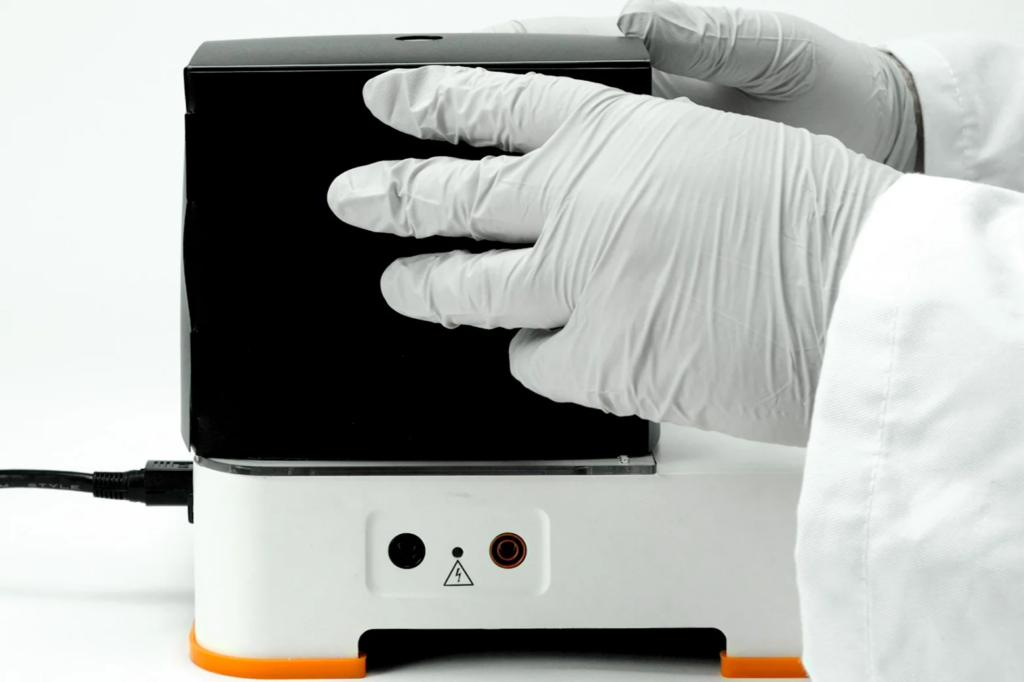
    If your Bento Lab transilluminator is in direct light, you can block out some of the incoming light with one hand against the Gel Imaging Hood to get better contrast.

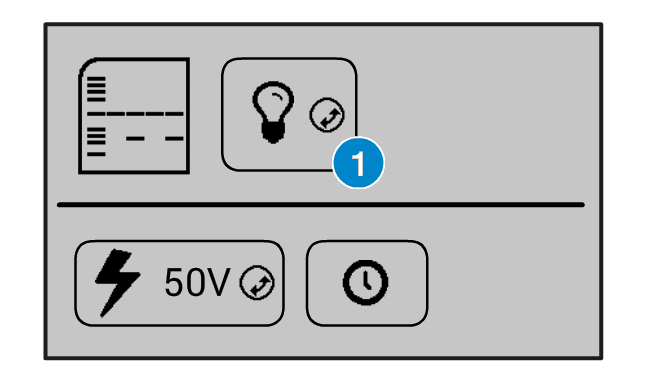
    On the Bento Lab interface, you can turn the transilluminator light on by selecting the light bulb icon (1) and clicking the orange wheel button.

    You can also increase and decrease the intensity of the light by selecting the light bulb icon, holding down the orange wheel button with two fingers, and rotating it left or right.

    By placing your smartphone camera lens over the orange filter at the top of the Gel Imaging Hood and activating your phone camera, you will be able to see the bands of DNA fluoresce in the gel. You can then take a digital photograph to document your gel results.

    If you have a smartphone with a “Pro” camera mode, you could try manually adjusting the focus so that it focuses exactly on the bands of interest to get a better image.

    Another way of visualising the agarose electrophoresis gel is to use the orange lid of the electrophoresis tank as a filter for visualisation. This method is best suited for use in a dark room, or for a quick visual check while the gel is running.

    To do this, first remove the lid and wipe away any condensation (if it is present), and then replace the lid. Through the orange lid, you will be able to see the bands of DNA fluoresce at their positions in the gel.

    To photograph the gel using the orange lid, remove the lid, wipe away any condensation, and hold it over your phone’s camera lens to take a picture and document your experiment’s results. However, the contrast will be inferior to images using the Gel Imaging Hood unless the room is very dark.

  5. Analysing your results

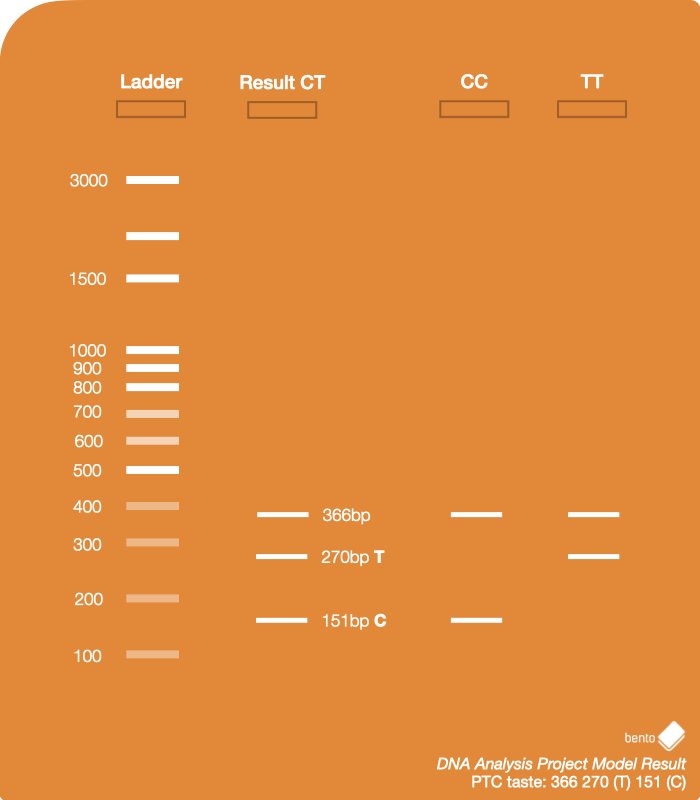
    Compare the picture of your gel to this example result, which has been run with all variations. Your sample should correspond to one of these variations.

    1 – Ladder – 100 bp DNA Ladder

    2 – Result CT – Control (366 bp), T allele (270 bp), C allele (151 bp)
    This result shows a person with a copy of both the T allele and C allele, so someone who is heterozygous. The ability to taste bitterness is dominant, so the person is likely to be able to taste bitterness.
    3 – CC – Control (366 bp), C allele (151 bp)
    This result shows a person who has both copies of the C allele, so homozygous dominant. This person should be able to taste bitterness.

    4 – TT – Control (366 bp), T allele (270 bp)
    This result shows a person who has both copies of the T allele, so homozygous recessive. This person is likely to be unable to taste bitterness.

    After you have taken good photos of the gel for your documentation, you can dispose of the gel in your regular trash.

    Disposal of agarose gels is a standard waste disposal procedure followed by research labs. If you have questions, get in touch with us.